Voces que transforman Charlotte: Fragmentos

By VozEs

Los fragmentos presentados en este espacio forman parte de una antología comunitaria bilingüe impulsada por Irlanda Ruiz Aguirre y HabilidadX en Charlotte, Carolina del Norte. El proyecto ha sido construido a través de talleres guiados de escritura y edición, donde las historias surgen de las experiencias reales de integrantes de la comunidad latina.

Más que una recopilación de textos, esta iniciativa busca amplificar voces que con frecuencia permanecen fuera de los espacios tradicionales de publicación, creando relatos que dialogan con la ciudad que habitamos y con quienes la construyen día a día. Cada historia ha sido desarrollada no solo como testimonio, sino como una obra viva capaz de generar conexión, reflexión y sentido de pertenencia.

El proyecto culminará con la publicación de una antología colectiva el 5 de agosto de 2026. La portada del libro fue ilustrada por el diseñador mexicano Jacobo Strimling.

Un total de 15 autores fueron seleccionados para formar parte de esta publicación. A continuación, compartimos fragmentos de algunas de las historias que integran esta antología y cuyos autores compartieron con VozEs.


No vinimos a desaparecer

El quiebre llegó un martes. Uniforme doblado sobre la silla. Rodillas que ardían. Libreta de gastos abierta como una sentencia. Él caminaba. Ventana. Cocina. Ventana. Cocina. Como si el movimiento pudiera resolver lo que las palabras no podían.

—No vuelvo —dijo ella.

Él se detuvo en seco.

—Es el primer día.

—Es el mismo día. Otra ciudad. Otro trabajo. Mismo olor. Mismas miradas.

El silencio que cayó entre ellos pesaba más que cualquier argumento.

—Tenemos treinta días —dijo él—. Después de eso, nada.

—Lo sé.

—Entonces explícame qué hacemos.

Ella lo miró directo a los ojos.

—Hoy sentí que desaparecía.

—¿Qué?

—Me vi desde afuera. Sonriendo. Asintiendo. Moviéndome. Pero yo no estaba ahí. Era un cuerpo en automático, haciendo lo que le habían enseñado. Nada más.

Él conocía esa sensación. La había sentido servir el plato número cien de la noche. Reírse del chiste número mil sobre su acento. Decir «gracias» cuando alguien le dejaba dos dólares de propina después de una cuenta de ochenta.

—Pasa. Es parte de…

—¿De qué? ¿De adaptarse? —lo interrumpió ella—. ¿Sabés cómo se llama adaptarse tanto que ya no te reconocés? Se llama desaparecer.

La palabra quedó flotando. Desaparecer. No morir. Algo peor. Estar vivo y no estar. Él se sentó. De pronto no tenía fuerzas para seguir caminando.

—¿Y qué querés que hagamos? —Su voz se quebró en la última palabra.

Ella caminó a la ventana. Afuera, el cardenal rojo estaba en su rama.

—Ese pájaro no pidió permiso para estar ahí —dijo—. No se adaptó. No se hizo pequeño. Simplemente es.

—Es un pájaro.

—Y nosotros también somos. Pero aprendimos a encajar.

Él respiró hondo.

—Tengo miedo.

—Yo también. Pero tengo más miedo de despertar en diez años y no saber quién soy.

No fue un grito. Fue un susurro. Pero en ese apartamento vacío sonó como una declaración de guerra.

¿Por qué decidimos contar esta historia?

Escribimos para nombrar lo que muchos viven en silencio. Que adaptarse puede significar desaparecer. Que hay una línea delgada entre integrarse y borrarse. Que sobrevivir no es lo mismo que existir.

Y nosotros no vinimos a desaparecer.


Alejandra Daza (Tunja, Colombia) Pedro Cordido (Caracas, Venezuela), 4 años viviendo en Charlotte

_________________________________________________________________________________________

El costo de cumplir un sueño

Salir fue difícil, peligroso, desordenado y me dio mucho miedo pasar por esas trochas, esos pasos ilegales donde muchos venezolanos han perdido la vida para llegar a Colombia; sin embargo, más me asustaba quedarme. La luz que escaseaba en la ciudad la empecé a ver en la frontera.

¿Por qué decidí contar esta historia?

Decidí contar esta historia para mostrar que emigrar no es solo cambiar de país, sino sobrevivir, reconstruirse y volver a encontrar quién soy lejos de casa.

Yuliana Montiel (Venezuela), 3 años y 8 meses viviendo en Charlotte

_________________________________________________________________________________________


Aculturarse sin perder la esencia

Fue entonces cuando me hice una pregunta clave:
¿Cuánto tengo que desaprender para volver a aprender y lograr un balance sin perder mi esencia? No solo sobrevivo; transformo y enriquezco cada lugar que toco. Cada paso confirma un orgullo que no se negocia.
Qué bendición ser maracucha de corazón.

¿Por qué decidí contar esta historia?

Me tomó tiempo entender que adaptarme a otra cultura no significaba dejar de ser yo, sino aprender a moverme entre dos mundos sin perder mi esencia.

Magbis Núñez Love (Venezuela), 24 años viviendo en Charlotte

_________________________________________________________________________________________


El reflejo de la metamorfosis: mi propio vuelo 

Me desperté y me vestí casi sin pensar. Franela blanca, pantalón beige manchado de productos químicos, zapatos grises. Frente al espejo me detuve unos segundos más de lo habitual. No era vanidad; era desconcierto. No me reconocía. El rostro sin maquillaje, los ojos cansados, la ausencia de esa urgencia por avanzar y de la frase inspiradora que solía repetirme cada mañana como un ritual”.

¿Por qué decidí contar esta historia?

Quiero que otros migrantes se inspiren y confíen en que también llegará su momento de reencontrarse con su pasión profesional.

Adriana Henriquez (Venezuela), 6 años viviendo en Charlotte

_________________________________________________________________________________________

La madrugada que empezó mi renacer.

La central de autobuses estaba casi vacía. La luz amarillenta caía sobre el
piso húmedo y el eco de los pasos ajenos parecía más fuerte de lo normal.
Caminé hacia la sala de espera y me senté en una banca de metal fría. El frío
atravesó mi ropa y se me metió en los huesos. Abracé mi maleta contra el
pecho como si fuera un escudo, como si pudiera protegerme de lo que estaba
por venir.
Las manos me temblaban. Por un instante miré la puerta. Podía regresar,
podía decir que no estaba lista, podría volver a esa casa donde las cosas se
habían ido vaciando poco a poco.

¿Por qué decidí contar esta historia?

A veces el renacer comienza cuando ya no podemos seguir quedándonos.

Leticia Aguilar (México), 6 años viviendo en Charlotte

_________________________________________________________________________________________

El Sonido de Code Switch

«Espera, ¿qué clase de acento es ese?”
“¿Qué dijiste?”
“¿Pero de dónde eres?”
“Ahhh, pero entonces tú no eres peruana, eres americana.”
Sin embargo, el sentido de pertenencia comenzó en casa.
Las conversaciones de sobremesa se alargaban los domingos por la tarde. La cocina olía a cebolla y ajo sofritos: Ají de Gallina, Causa, Papa a la Huancaína, Tallarines Verdes. El castellano y el inglés flotaban por cada cuarto.
Era bailar con mi mamá en la sala, comer postre de chocolate, darles pan a los patos con mi papá. Ir a misa los domingos abrazando mi muñeca Cabbage Patch Kids. Trepar árboles.
Pero afuera, las cosas eran distintas.
Fuertes acentos sureños. Almuerzos diferentes.
Historias diferentes.
Yo sonreía durante el día.
A veces regresaba a casa con lágrimas.»

¿Por qué decidí contar esta historia?
Para reconocer que la adaptación nos hace crecer, vivir y amar.

Claudia A. Ramos (Perú), 22 años viviendo en Charlotte

_________________________________________________________________________________________

El valor de no rendirse

Lo que más me dolía no era solo la detención. Era haber sido considerada, detenida y procesada como una criminal. Era la sensación de vulnerabilidad. La separación forzada de mi hijo. Apenas lo había enviado a mi país para protegerlo del ambiente tenso que vivíamos. Era tan pequeñito, frágil y hermoso. En medio de todo ese caos emocional, mi mayor temor era él. ¿Cómo estaba? ¿Qué entendería algún día de todo esto? ¿Por cuánto tiempo no podría verlo? ¿Cuánto duraría la separación?
Sentada frente al banco, con ese cheque en la mano, pensaba en mi hijo más que en mí. El monto era de $53.12, menos de los cien dólares con los que había llegado a Estados Unidos años atrás. Ese cheque representaba, en ese momento, mi único recurso inmediato.

¿Por qué decidí contar esta historia?
Con esta historia de vulnerabilidad, te invito a no renunciar a ti mismo ni a tus sueños.

Alba Sánchez (Costa Rica), 23 años viviendo en Charlotte

_________________________________________________________________________________________

La Flama

“Levántate ya, hija. Ya es hora.”

La escuché cuando la noche todavía no había decidido soltarse del todo. Como una flama que se rehúsa a extinguirse. No supe si estaba despierta o si el sueño había abierto una grieta por donde se cuelan las voces que no piden permiso. Llegó bajito, como llegaban siempre sus palabras, sin urgencia y sin mucho ruido. Después sentí su mano tibia apoyarse en mi antebrazo, con la misma firmeza tranquila con la que me despertaba de niña.

¿Por qué decidí contar esta historia?

Poco hablamos de esas personas que dejamos esperando volver a ver. De los abrazos que posponemos creyendo que el tiempo será generoso con nosotros. Como migrantes, muchas veces ese día nunca llega.

Sorayda Díaz León (México), 14 años viviendo en Charlotte

_________________________________________________________________________________________

Hopscotch

While I was still living in my car, I managed to find jobs as a math teacher at a high school and as an ESL instructor at Central Piedmont Community College in the evenings.

When I received the divorce papers from my ex’s lawyer, I couldn’t help but immortalize the end in a poem.

Obituary

The Collins’ marriage died at age three on July 31st, 2009
Visitations will occur till October 15th, 2010
Funeral at Lawyer’s office some day in October 2011.

One of the most popular interracial marriages in North Carolina has died at a very young age.
After being in the ICU for two years, the couple has decided to unplug the cord.

His stoic figure will always be remembered amongst friends.
His blond hair, green eyes, perfect teeth and height will no longer be associated with his counterpart.

His Harley-Davidson paraphernalia will depart with him, leaving nothing but a rumbling noise dimmed with distance.

She claims: her life back, the dog, and a poetry book she acquired before the wedlock.

Viewings will be celebrated at her apartment.
Shoes are optional.
Wine and laughter are mandatory.

It has been decided that his funeral will be closed casket.
Hers will be open to anybody who wants to dance to rhythms of cumbia, skirts and candle lights to incinerate the past.

Do not send condolences.
Only flowers and sincere hugs are accepted.
No RSVP necessary.

¿Por qué decidí contar esta historia?

Me di cuenta de que nunca he hablado de esta parte de mi vida. Quiero que las personas se sientan libres, no avergonzadas, de las tragedias y los abusos que ocurrieron durante su infancia. Cuando una persona habla, otras se suman, y es entonces cuando ocurre la verdadera libertad.

Kurma Murrain (Colombia), 22 años viviendo en Charlotte.

Para mayores informes, contactar directamente a la editora del texto, Irlanda Ruiz Aguirre o en http://www.habilidadx.org

La antología fue hecha posible gracias al apoyo del Creative Growth Grant de la ciudad de Charlotte.

Fotos blanco y negro: Héctor Vaca Cruz

Foto portada: Cortesía Jacobo Strimling

My CLT Home

By Jacobo Strimling
This illustration supports the Here to Stay project with a direct and powerful statement: “This is my home,” Mi Casa CLT.

In this piece, I depict the city of Charlotte through its distinctive skyline—as has been done countless times before—but I’ve reinterpreted some of Uptown’s most iconic buildings using colors and shapes that evoke Latin culture. For the roof of the house, I incorporated visual elements from the VoZes logo.

Part of our goal is also to highlight the cultural richness that the Queen City has to offer. That is why we have included iconic venues such as the Harvey B. Gantt Center for African-American Arts + Culture, the Mint Museum Uptown, and the Bechtler Museum of Modern Art—which together form the Levine Center for the Arts—along with St. Peter Catholic Church, Charlotte’s oldest Catholic church, and the Belk Theater, the main venue of the Blumenthal Arts Center.

Just like in the Charloteanos project, this image celebrates the work, presence, and influence of the Hispanic community. I hope that, in addition to bringing color to homes and workspaces, it will become a statement of identity and belonging: “I’m here to stay, because this is [also] my home.”

Jacobo Strimling is a prolific graphic designer, visual artist, and journalist who has been based in Charlotte since 2003. He has dedicated his talent to creating visual experiences that connect art, community, and purpose. His work reflects a deep belief in the power of art as a tool to inspire, communicate, and build a better world.

His project “Charloteanos,” which consists of an initial series of 11 illustrations of prominent members of the Latino community, is currently on display at the South Boulevard Library.

Cristina Lozano and the Tradition of the Morning Cup of Coffee

By VozEs

The aroma of coffee can travel farther than a suitcase.

Sometimes it travels across entire countries before settling once again in a kitchen, a conversation, or a memory. For Cristina Lozano, that scent always brings her back to the Ecuadorian coast—to the humid heat of the beach, to family mornings, to the sound of the blender whirring as it prepares fresh juices, and to a cup of coffee that would appear even under the intense Pacific sun.

“It’s funny to have a cup of coffee on the beach when it’s 80 or 90 degrees,” he says with a laugh. But in Ecuador, coffee was never just for cold weather or fancy coffee shops. Coffee was everywhere. At family tables. When visiting friends. At afternoon snacks with Grandma. At breakfasts with roasted plantains and eggs. In those homes where there always seemed to be a hot pot waiting for company.

Long before she founded Ikigai Bold, before the premium cocoa and the rebranding that has now made it a fixture in Charlotte’s markets and cultural spaces, Cristina was a little girl drinking coffee with her grandmother—whom she calls “Mami”—as they dipped Ecuadorian roscas into their hot cups.

That’s why, when he moved to the United States, something struck him as odd almost immediately: coffee seemed to be off-limits to children here.

“It seemed really strange to me,” she recalls. Because for her, coffee didn’t symbolize adulthood or dependence. It symbolized closeness. Home. A shared moment of respite.

Cristina officially moved to Charlotte in 2006, although she had been traveling back and forth between Ecuador and New Jersey for years to visit her father. The city she found back then was very different from what it is today, and, like many immigrants, she had to start over from scratch. She had studied graphic design in Ecuador, but the language barrier and the difficulty of having her credentials recognized led her to other jobs: sales, Mary Kay, and later childcare as a nanny.

Creativity, however, never disappeared.

First came the hand-painted bags as part of her Loggy Bags project, where she transformed tote bags into portable works of art. Then came cocoa. And finally, coffee—as if, sooner or later, it were inevitable that she would return to what had always been a part of her life.

With Ikigai Bold, Cristina didn’t just want to sell Ecuadorian products. She wanted to evoke emotions. She wanted people to taste a piece of chocolate or a cup of coffee and realize that behind it all lay a place, a memory, and an entire family history.

“We’re going to show the world that Ecuador has great coffee too,” he explains. For a long time, he says, the spotlight seemed to be on other Latin American countries, while Ecuador remained on the sidelines of the global coffee conversation.

Its reinvention in 2025 also became a way of returning to its roots. The coffee shops began to be called Suyu and Amanai, words in the Quichua language associated with origin and rebirth. The green and gold colors of the packaging were chosen to evoke abundance, health, family, and connection.

As she speaks, Cristina constantly mentions the beach, family meals, the smell of breakfast, and conversations over food. She talks about Ecuador as if recalling sounds rather than images. The blender running in the mornings. Coffee served even when it was hot outside. The family gathered together.

As she speaks, Cristina constantly mentions the beach, family meals, the smell of breakfast, and conversations over food. She talks about Ecuador as if recalling sounds rather than images. The blender running in the mornings. Coffee served even when it was hot outside. The family gathered together.

Perhaps that is why coffee ends up being much more than just a product in its history. It is a way to carry on a tradition far from home. A way to preserve everyday memories that often seem small, but that ultimately help shape one’s identity.

Every morning, he follows the same routine: first water, then coffee. As he sips that cup, he thinks about what he did the day before, not necessarily about the future.

“I don’t think much about the future,” he admits. And he says it calmly, not fearfully.

Perhaps that is why his project feels so human. Because it doesn't stem from an obsession with rapid growth, but from something much more personal: sharing flavors, memories, and glimpses of Ecuador with others.

Charlotte is full of stories of immigrants built on great sacrifices, but also on small rituals, and nostalgia sometimes comes in the form of hot coffee, served just like it used to be at home.

A whirlwind of energy in Charlotte: Sydney Duarte

By Sorayda D. León

There are people who seem to carry an entire landscape within them. It is as if certain places in the world have not only left their mark on them, but continue to breathe through them. In Sydney Duarte’s case, that place has a name: Lake Atitlán, in Guatemala.

Surrounded by volcanoes and imbued with an energy that various cultures describe as spiritual, Atitlán still lives on in the way Sydney builds community, listens to others, and transforms spaces into sanctuaries.

“They say there are energy vortexes around the Earth, and that’s one of them. You can feel something special in the air,” he shares during our conversation.

Perhaps that is why, when exploring projects likethe TAOH Outdoor Galleryor Luminous Lane in Charlotte, one feels something that is hard to explain rationally: a blend of freedom, collective care, and a sense of belonging. It is as if these spaces had been built not only with wood, paint, and sculptures, but also with memory, grief, migration, and hope.

Sydney doesn't talk about art as a decorative object; she talks about it as a human necessity, as a form of healing.

“So many people come here saying that this is their happy place, their sanctuary, their therapeutic space,” she explains, pointing to the walls covered with murals, swings, makeshift sculptures, and people creating without fear.

TAOH Outdoor Gallery started out as a space for painting, but it eventually became something much bigger: a gathering place for artists, skaters, photographers, book clubs, cyclists, musicians, and people who simply needed some company. It’s a space that’s open 24 hours a day, lit by solar power, where the only rules are respect and the freedom to express oneself.

In a city where institutional art can often feel distant or inaccessible, Sydney embraces a different approach: art as a unifying force for the community.

And perhaps that way of caring goes back much further.

During the interview, Sydney constantly recalls her grandmother María, whom everyone affectionately called “Mita” in Guatemala. A woman who raised eight children on her own after her husband died when Sydney’s father was just three years old. In addition to supporting her family, she also ran a school. She remembers her as an almost magical figure, with silver hair tinged slightly with purple, crossing the waves of Lake Atitlán in small boats at sunset.

“I can feel my grandmother with me all the time,” she says. And in fact, that presence seems to extend to everyone who comes to her spaces seeking refuge, conversation, or simply a place to be without judgment.

Sydney grew up straddling two worlds: Kentucky and Guatemala. The daughter of a Guatemalan father and an American mother, she spent much of her life trying to figure out how to navigate both identities at the same time. In Guatemala, she found something that would profoundly shape her worldview: a community that embraces before it questions.

“It doesn’t matter whether you speak the language or not. They welcome you, feed you, dance with you, and make you feel like one of them,” he recalls.

That philosophy of belonging permeates everything he does today.

For years, she worked in the corporate world in Charlotte. Sixteen years of rigid structures, endless hours, and a life that gradually began to pull her away from her creative center. Until one day she decided to leave. She traded certainty for movement.

He began traveling through Couchsurfing, staying with strangers in different parts of the world, sharing stories, volunteering, and engaging in creative projects. He traveled through New Zealand, Australia, Bali, South Africa, Madagascar, and much of Latin America.

In every place, he left something behind: murals, workshops, human connections, or simply a listening ear.

“Deep down, we humans all want the same thing: connection,” he reflects.

His travels also strengthened another important aspect of his work: advocating for indigenous communities and nature. In Brazil, for example, he works alongside Asháninka communities fighting to protect Amazonian territories threatened by illegal mining, logging, and deforestation. Part of his future artistic vision includes painting indigenous faces in urban spaces to compel people to stop and ask themselves who these people are and why their stories matter.

In Sydney, art is never separate from everyday life. Nor is it separate from emotional healing.

She speaks openly about trauma, anxiety, depression, and the urgent need to create safe spaces for those who have never had them. She firmly believes that unexpressed pain ends up being projected onto others, and that art can break that cycle.

“If you don’t heal the trauma, it ends up being taken out on other people,” she explains.

That’s why he insists so much on letting others take up space—whether they’re painting, writing, or simply existing—but always leaving their mark.

Perhaps that is the true meaning of his projects: not just to beautify walls, but to remind people that they belong.

At a time when so many migrant communities are living amid uncertainty, displacement, and fear, Sydney seems determined to create small emotional havens where it is still possible to breathe.

Places where someone can arrive without knowing a soul and end up feeling seen, just as they did at Mita’s house by Lake Atitlán. It’s as if that Guatemalan vortex of energy had crossed borders to settle quietly in Charlotte.

Learn more about Sydney Duarte on herInstagram

Photos: Courtesy of the artist

Serial: Chapter 5

By Loli Molina

M. pren. Literary work, novel, or other work

any work published in installments in

a special section of the newspapers. 

A gruesome novel of little literary merit. 

Vox 1 Encyclopedic Dictionary. © 2009 Larousse Editorial, S.L.

MARIELITA'S BETRAYAL

Chapter 5

With the card still in her hand, she held it up to the door reader and heard it click. She felt the warm doorknob and smiled. She walked down the suite’s hallway, guided by the sound of the television. As her breathing returned to its natural rhythm, she reached the small sofa in front of the TV, where Mariana was sitting, laughing heartily.

Sitting cross-legged on the sofa with a bowl of popcorn on her lap, Mariana seemed oblivious to the world.  

“Hi, sis,” said Mariana with her mouth full.

“Hi,” Marielita replied, hands on her hips.

“What happened?” Mariana asked when she saw his face. “Why are you coming over at this hour?”

“We had an agreement. Have you forgotten?” Marielita said firmly.

Mariana slammed the TV off, pushed the bucket aside, and motioned for her twin sister to sit next to her, patting the cushion. Marielita sank into the sofa, dismissively brushing aside some food scraps.

“What happened?” Mariana frowned. “Is it Ángel? Another fling?” 

“Another one, but I don’t care about that anymore.” Marielita wiped a furtive tear from her eye with her hand. 

“What do you mean you don’t care anymore?” Mariana reached for his hands with determination to clasp them.  

“It was comfortable…” Marielita met her sister’s gaze with a familiar coldness. “But there’s no point in pretending anymore.”

Mariana swallowed hard, and her fingers went limp. The air in the suite grew heavy, almost unbreathable.  

“I never thought it would happen, to be honest,” he added with a nervous smile. 

“If you don’t feel up to it, you don’t have to do it. I’ll do it myself.” 

“I’m not going to leave you to handle this alone,” Mariana replied immediately. “You’re family, and I promised to help you. I keep my word.” 

—Thank you. 

Silence fell over the two of them. Only they knew the plan they had been hatching for years. A secret that, starting that night, would come to life. 

“Would you like some herbal tea? I have chamomile and linden. It’ll do you good.” 

—Yeah. And popcorn! Put on whatever you were watching. I need a good laugh before we get started.

Mariana turned on the TV and went into the small kitchen. On the screen, George Costanza was gesticulating frantically, trying to explain to Elaine the embarrassing concept of “shrinkage” after swimming in a pool.

Mariana arrived with the tea and popcorn and sat down next to Marielita. They had everything they needed to carry out their plan.

“This is one of my favorite scenes. It’s hilarious,” said Marielita, her smile returning as she fixed her eyes on the TV while George sat there dejected.

“That’s great,” Mariana replied.

Read the previous chapters of *Marielita's Betrayal*.

Chapter 1

Chapter 2

Chapter 3

Chapter 4

The Art of Rebuilding Oneself Through Dance: Salas Agency

By Sorayda D. León

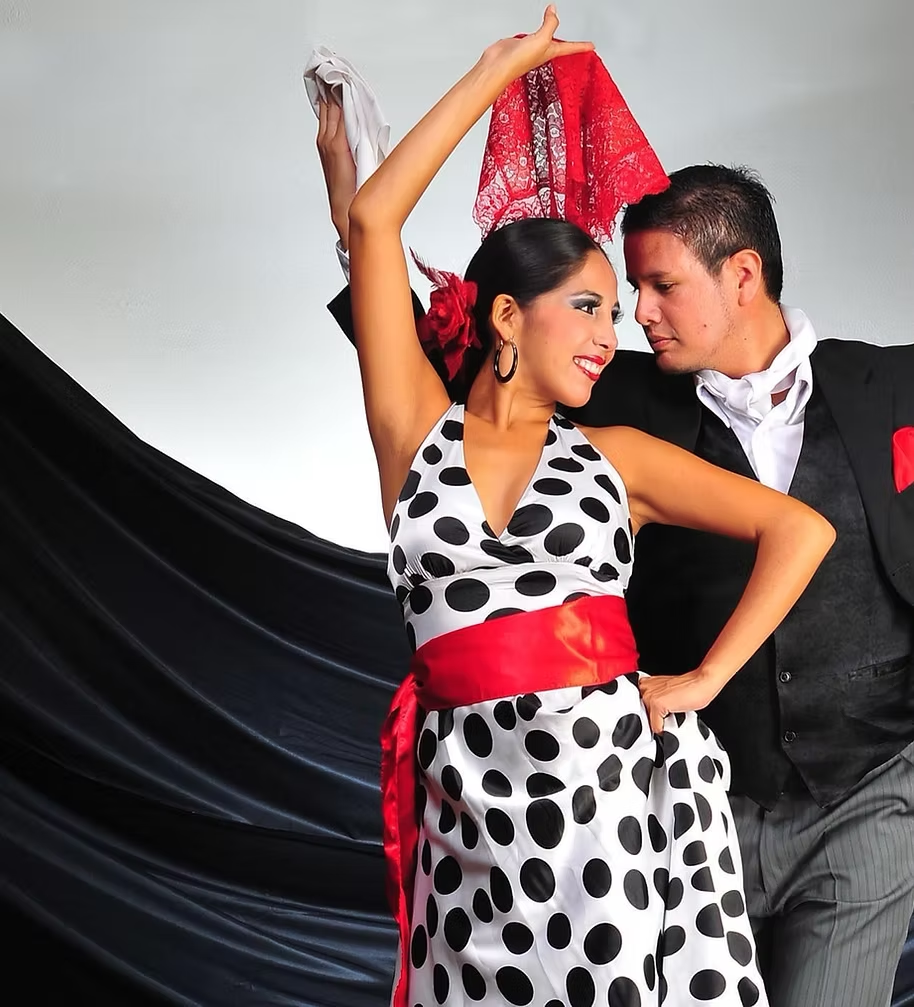
Ángela Castillo and Mauricio Salas have spent more than two decades building a life together amid performances, rehearsals, and cultural projects. They met at a dance workshop at university in Peru, and since then, dance has been a part of virtually every major milestone in their lives: love, friendship, family, children, and now their experience as immigrants.

Before moving to the United States, both of them already had extensive experience in cultural management and dance in Peru. But when they arrived in Charlotte in 2022, they planned to focus primarily on cultural projects and step back from the stage for a while. However, the city, the Latino community, and a series of coincidences eventually led them back to dance.

“It seems like they want us to dance here,” Angela recalls with a laugh.

And so a new chapter began for them: not only as migrant artists, but also as cultural advocates determined to build bridges between Latino communities through art.

Their stories are deeply intertwined with Peruvian culture. Mauricio worked for over twenty years in cultural management and artistic production in Peru, developing national and international projects. Ángela, in addition to being a communications professional, has been a member of dance companies since she was young. Together, they founded an artistic group in Peru that remains active today, two decades later.

Moving didn't mean giving up that experience, but rather figuring out how to turn it into something new.

They first arrived in Orlando, but after several visits to Charlotte—where part of Mauricio’s family was already living—they began to consider the possibility of settling down there. They discovered a Latino community that was small compared to those in other cities, but deeply active and with a real need for cultural spaces.

That is how Salas Agency was born—a platform created to promote Latin artists, connect cultural projects across cities, and develop shows that help highlight the talent of immigrant communities.

But the immigration process also had its difficult moments.

Both speak of the grief involved in leaving behind a life built up over the years. Friends, routines, professional recognition, cultural spaces, family. Everything changes. And often, the body keeps moving forward before our emotions can fully grasp what is happening.

Ángela especially remembers the emptiness of going from a life full of projects and activity in Peru to long mornings alone at home while her children were at school. “My world felt empty in that sense,” she says.

Mauricio, for his part, describes a sense of loss more closely tied to professional and cultural dislocation. His entire experience had been built around Peruvian culture. Moving abroad forced him to ask himself who he was outside of that context.

However, they both agree on one thing: art ended up becoming the tool that allowed them to rebuild themselves emotionally.

And dance reappeared, almost as if it were inevitable.

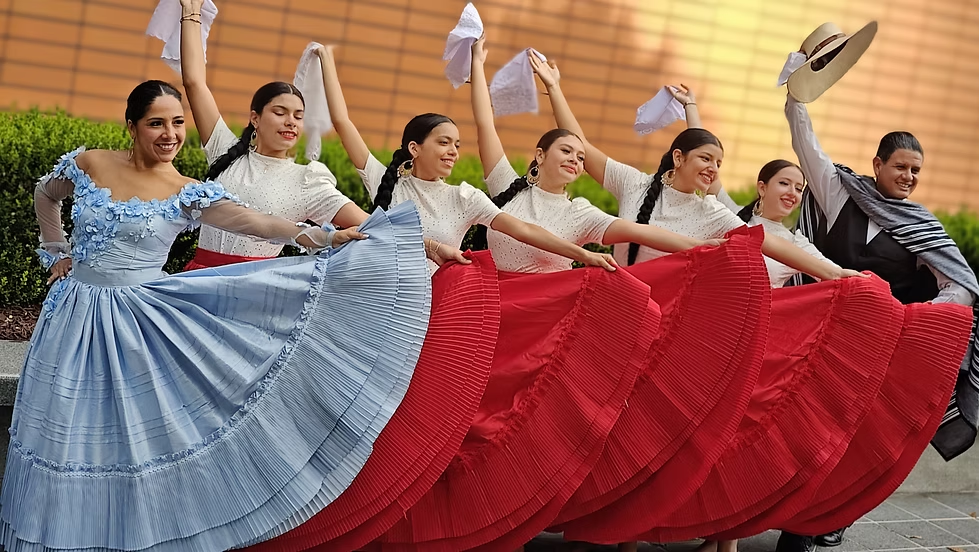
What began with small performances and competitions quickly grew. Today, they produce shows, participate in festivals throughout the city, and train new generations of dancers through Perú Expresión, a project that now also has a branch in Charlotte.

Her classes bring together young people from Peru, Colombia, and the United States who were born here, many of whom are discovering traditional Latin American dances for the first time. For them, that cultural exchange is precisely the goal.

“When you migrate, you’re no longer just Peruvian or Mexican. You become part of a larger Latino community,” says Ángela.

That vision is at the heart of everything they do.

Through educational programs and partnerships with other cultural organizations in Charlotte, they aim to show that dance can also be a form of remembrance and a sense of belonging. They don’t just teach steps or choreography; they teach stories, contexts, and roots.

They also work to help professionalize Latino cultural projects within the United States, particularly in cities where immigrant communities are still growing and do not always have strong artistic infrastructure.

Perhaps one of her most personal projects is *Memories of Peru*, a piece presented at Boom Charlotte that tells the story of her life and migration through five traditional Peruvian dances.

There is no dialogue. There is no verbal explanation.

Just movement.

The play tells the story of how they met, how they grew up together, how they emigrated, and how they tried to rebuild their lives emotionally far from home. And, as they say, many people were able to connect with the story even without knowing the dances or their cultural significance.

That's when they realized something important: dance has its own language.

One that can transcend borders, languages, and nostalgia.

When they talk to each other, you can still sense the bond between two people who have lived through several different lives together. They correct dates, finish each other’s sentences, and recall coincidences as if they were still discovering new connections in their own story. The show *Memories of Peru*, for example, ended up premiering on the exact same day as the couple’s wedding anniversary—almost without planning it.

And perhaps that sums up pretty well what they stand for.

Because beyond Peruvian dance, competitions, or cultural festivals, what Ángela Castillo and Mauricio Salas are building in Charlotte is a sense of community.

A reminder that moving to a new place can also mean rediscovering parts of yourself that you thought were lost.

And that, sometimes, dancing can also be a way to stay.

Learn more about the couple on their website

https://www.instagram.com/salas.art.agency/?hl=en